Challenge Context
The increasing frequency and intensity of
extreme heat events, compounded by the urban heat island (UHI) effect,
significantly impact building performance, energy demand, and outdoor thermal
comfort. Air conditioning units elevate temperatures at street level by
approximately 2 °C (day) and 2 to 4 °C (night). The resilience of the building
against overheating during heat waves is as important as the city resilience
with increased outdoor temperatures. Mitigation options are needed for both in
ways that building load does not increase substantially, and pedestrian level
outdoor temperature remain below heat stress level.
In this challenge, there are two aspects to
consider in the Mediterranean City of Beirut that has a moderate humid climate
but has also been affected in recent years with heat waves that last for weeks.
The aim is to evaluate the impact of passive and active design strategies of
building envelop and HVAC systems as well as outdoor interventions that include
bioclimatic design elements on building cooling demand and outdoor thermal
comfort. In other words, it is aimed to quantify the impact of these
interventions on:
- Building
Energy Performance (BEP) as measured by building load and energy consumption.
- Outdoor
Thermal Comfort (OTC) as measured by the Physiological Equivalent Temperature
that measures the extent of thermal stress.
Each group will generate the baseline
scenarios of building and outdoor performance. Then, it is expected to develop
and assess proposed solutions/interventions that improve the baseline building
performance and the outdoor thermal comfort while considering associated costs.
Recommendations for passive and active measures are sought to improve building
and urban resilience and should be provided based on deep analysis of the
performance of the building and the urban system.
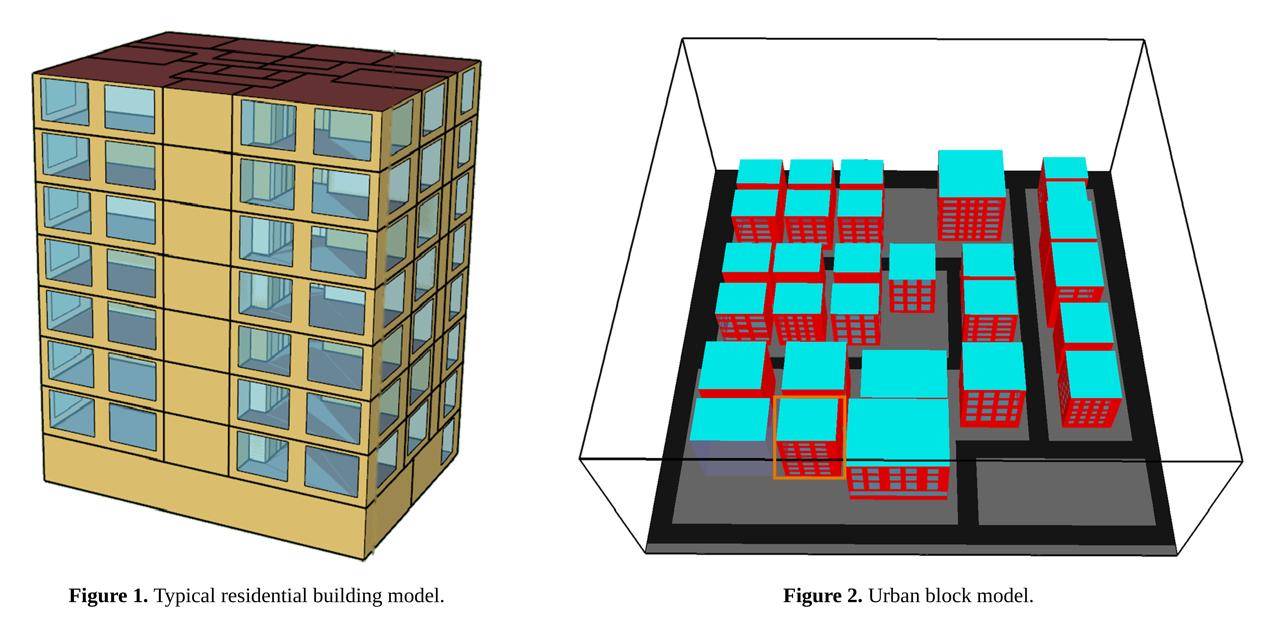
A hypothetical building is proposed in Beirut
climate (see Figure 1). The building is placed in
a neighbourhood with a given street and urban structure (see Figure 2).
Baseline Scenario
for building performance and outdoor pedestrian level conditions for comfort
A baseline scenario is
to be established in Beirut climate for both the building and the urban area to
predict energy performance and outdoor thermal comfort level as follows:
1.
A clean, multi-zone baseline EnergyPlus model is to be developed
for the provided typical residential building to predict and evaluate energy
performance while selecting a conventional HVAC system.
2.
Using ENVI-MET for a typical neighbourhood in Beirut, a baseline urban
microclimate model is established to predict outdoor pedestrian level
temperature, humidity and associate thermal comfort.
List of Mitigation Measures to
be simulated individually or in combination
a) Building Interventions
i) Façade Interventions
- Wall-related intervention (insulation, wall material)
- Roof-related intervention (insulation, roof layering material)
ii) Glazing and Solar Control Interventions
- Glazing type
- Shading type/design
- Apply 25% or more reduction in East/West/South Window-to-Wall Ratio
(WWR)
iii) Active Interventions
- Apply Night Ventilation
- Increase the HVAC COP to 4
b) Outdoor interventions
- Vegetation
- Outdoor Shading
Use the Combined
Building Scenario together with the selected best outdoor intervention to
simulate the Combined Building Scenario for the same specific day and then:
- Extract the Total Site Energy
[kWh/day];
- Compare the result with the baseline
building simulated for the same day;
- Calculate the final percentage
reduction in energy consumption.
Report and discuss the final impact of combining
the building interventions with the best outdoor intervention on building
energy performance. Feel free to use the challenge's community discussion page to interact, share solutions and ask question.